Dalongdong used to be inhabited by Pingpu-Ketagalan people’s “Balangbeng tribe”. “Balangbeng” was also called Balanbeng or Dalangbeng, both of which were transliteration of Pourompon. Later on, Dalangbeng was named “Da-long-tong”, and then re-named Dalongdong because of studious residents in the area. Dalongdong is close to where Danshui River meets Keelung River; it sits in the Datong District of Taipei City.
Among Han people’s settlements in Taipei Basin, Dalongdong came into existence only after Manka
1. About the Construction of Baoan Temple
According to Danshui Sub-prefecture Gazetteer, Baoan Temple was bankrolled in 1805 (year 10 of Chia-ching reign) for construction, which completed in 1830 (year 10 of Tao-kuang reign).
Special Report on Taipei Baoan Temple states that in 1742 (year 7 of Chien-lung reign) certain immigrants went back to Pai-chiao Tzu-chi Temple in their Tung-an, Chuan-chou, motherland and begged the Baosheng Emperor to share out his spiritual powers to Taiwan. At first, the tem
Baoan Temple was originally funded by four local clans; the Wangs donated the land and the Chens, Changs, Tsais offered their supports. These major clans were often associated with the businesses of 44 kans (shops). As far as Baoan Temple’s sphere of worship, it covered the following three areas: Township One: Dalongdong, Huwei, Beitou. Township Two: He-shang zhou, Sanchong pu, Xinzhuang. Township Three: Dadaocheng.
There were three worshipping activities in a year: Baosheng Emperor’s date of birth (15th
In 1895 (year 21 of Kuang-hsu reign), the Treaty of Shimoroseki was signed and Taiwan was ceded to Japan. As Tang Ching-sung fled back to Amoy, Japanese troops attacked, captured, and brought chaos to Taipei. The explosion at Yuanshan arsenal affected Baoan Temple. In 1898 (year 24 of Kuang-hsu reign), Baoan was taken over by the Japanese, who established the third affiliated class of the National Language School, as well as a catering trade association. Later on, the school was renamed Dalongdong Public Sc
Years 1917-1919 (years 6-8 of Taisho reign) saw one major reconstruction of Baoan Temple. Fund-raising leaders included: Shen Chu, Chen Pei-ken, Lin Ming-te, Li Sheng-yuan, Cheng Ken-mu, Chen Chun-hui, Huang Tsan-chun, Lin Ching-tun, and Tsai Shou-san. The project lasted two years. To celebrate the successful completion of the biggest renovation to date, temple management planned five-day-long festivities, which started on January 18 (28th day of the 11th moon in year 8 of Taisho reign), 1920 (year 9 of Tai
Although Baoan Temple has a priest as its head, the real power is in the hands of the temple’s management. In early Taisho years, manager Wang Ching-chung’s poor job performance caused widespread dissatisfaction. Chen Wan-yi and twenty other Temple members initiated a meeting at Dadaocheng’s Tzu-sheng Temple and decided to dismiss Manager Wang. They then elected two managers out of each of the three townships, plus 30 other board members and a number of advisors. The term of the manager was six years. Manag
Baoan Temple’s management had accomplished quite many things during the period between the reconstruction and the Kominka Movement. One thing was the Confucius memorial ceremony. Before the Taipei Confucius Temple was built, and in as early as 1926 (year 15 of Taisho reign), the ceremony was held by the “Taipei Chung-sheng Society” at Baoan Temple. On September 22, 1927 (year 2 of Showa reign), Chung-sheng again held the same ceremony at Baoan.
The other thing was praying for rains. During a drought in y
In August 1945 (year 34 of ROC), Taiwan was retroceded. War damages meant bad shape everywhere in Taiwan; Baoan Temple was no exception. At the time, Baoan’s management had either passed away or drifted apart, the temple was left unattended. In 1950 (year 39 of ROC), with the retreat from Mainland, some 130 households of military and refugees landed at Baoan Temple. They occupied the east wing’s Buddha hall, the west wing’s Child-bearing Goddess hall, as well as the rear hall where the Five-grain Emperor re
Baosheng Emperor’s surname is Wu; given name is Ben (979-1036). His other honorifics: Wu Chen-jen (immortal), Wu Chen-chun, Hua-chiao Gung, etc. His courtesy name is Hua-chi; his style name is Yun-chung. A native of Pai-chiao Village of Tung-an County in Chuan-chou Prefecture, Fu-jian Province, he was born on the 15th day of the third moon in year 4 of the Taiping Hsing-kuo period (979) of Northern Sung Dynasty’s Tai-tzung reign. Born as a smart child with good memory, he studied extensively and memorized numerous books; his specialty was traditional Chinese medicine. At the age of 17, he was taken by some extraordinary person to have an audience with Goddess of the West, who taught him how to exorcise evil spirits. At the age of 24, he passed the provincial examination, and then served as a controlling inspector. He later on resigned to retirement and cultivated himself at Mt. Ta-yen in Pai-chiao. A lifelong vegetarian, he was never married. As a medicine man, he had saved countless people’s lives. On the 2nd day of the 5th moon in year 3 of Ching-you period (1036) of Sung Jen-tzung reign, as he had attained the perfect Way, fairy cranes came to pick him up. His country folks kneeled down and witnessed his ascension in the middle of the day. He was 58 years of age.
During his lifetime, Baosheng Emperor (Dadi) was known to have done medical miracles. For instance, he had applied eye drops to a dragon’s eye and removed foreign object from a tiger’s throat. After his ascension, Dadi repeatedly displayed his divine powers, which assisted the nation as well as the people. When Sung Kao-tzung was the crown prince and sent to be a hostage at the Jin Court, it was Dadi’s divine presence that saved Kao-tzung and escorted him back to China. After Kao-tzung had ascended the throne, he ordered the founding of a temple (the ancestral temple for Baosheng Emperor) and bestowed the title of Great Tao Immortal on Dadi.
Ming Cheng-tzu’s Empress Wen suffered from breast ailment and her imperial doctors had no cure. Dadi appeared as a Taoist priest and came to the rescue. He felt the empress’s pulse through a silk string and then cured her. Cheng-tzu wanted to compensate Dadi with gold, but Dadi declined and rode away on a crane. Cheng-tzu then expressed the appreciation by conferring the title of “Imperial Inspector at Heavenly Gate, Miracle Doctor of Compassion Relief, Great Taoist Immortal, and the Long-lived, Unbounded, Life-guarding Emperor.” Imperial robe and palace were also conferred upon Dadi. Dadi cured serious diseases and relieved many people; he was revered as the god of medicine.
Baosheng Dadi is guarded by the Thirty-Six Celestial Officials, whose figures were sculpted by Master Hsu Yen of Chuanzhou during 1829 ~ 1833 (9 to 13th, Emperor Daoguang, Qing dynasty). Each figure has one different animal ride depicted in vivid style, placed on the right and left sides of the Main Hall.
He is also called "Master General", which is different from "Tiger Lord" in folklore. His figure is sculpted in stone or wood and worshipped under the altar of Baosheng Dadi in the Main Hall. It is said that in the Song dynasty, a tiger once ate a woman, Since her hairpin pierced his throat, he felt in great pain. The tiger went to ask Master Wu for help. Master Wu rebuked him "It is the punishment from Heaven for killing people and animals. I can't save you. "The tiger did not leave, just stayed and lowered his head to repent what he had done. Touched by his sincerity, Master Wu then cured him. To thank Master Wu for his kindness, the tiger stayed by his side from then on. When the tiger was alive, he served Master Wu as his ride; after death, he still protected him loyalty. Thus, Master Wu transformed the fierce tiger into a deity. Since then, on every April 16, the ceremony of "General Tiger" is observed. He is thus honored as the "General Black Tiger".
Also known as the five-grain late-emperor, emperor-king of medicine, Mr. five grains, the late-emperor lord, epoch-era Yan emperor, Yan emperor Sir Shengnong, king of five grains, and king of millet, Shengnong Emperor is the same as the legendary Sir Shengnong. His surname is Chiang. Born in Li-hsiang, he grew up in the Chiang River area. Legend has it that: When his mother was visiting Hua-yang, she had a glimpse of the head of a dragon and then she went back home and got pregnant. Shengnong had a rather strange look: he was born bull-headed.
Sir Shengnong invented farming tools and taught people how to open up land and grow grains, so that people learned to shift from hunting to farming. He tasted all kinds of herbs while categorizing them; he also treated people’s illness. The Shengnong figurine that people worship usually has bare upper body, with ears of rice grain in his hand. Wearing tree leaves around the waist, the figurine has a primitive look that is quite different from the legendary image –“bull-headed body.”
Baoan Temple began to enshrine Shengnong Emperor because of the drought and famine that took place in Taiwan more than 100 years ago. People prayed to Shengnong Emperor for rain and got it in no time. To show their gratitude, people enshrine Shengnong Emperor in Baoan’s rear hall.
Ancient Chinese society used rites to regulate the form and scale of buildings; it was the requirements of rites that had created ritual structures like altars, temples, and shrines. The formation and development of these structures were considerably influenced by people’s reverence toward the gods in the altars, temples, and shrines. Such ritual architectures come in two categories: for gods of nature and for gods of humanity. Different gods receive different sacrifices and offerings, and the form and scale of their buildings differ with one another according to the statuses of their deity.
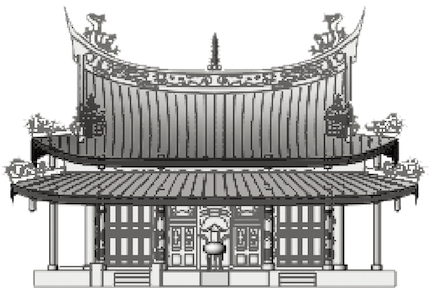
The presiding deity that Baoan Temple enshrines is Baosheng Dadi. Being a great Taoist saint of the Song dynasty, he was bestowed an emperor’s title and therefore entitled to the rites befitting an emperor. This 3,000-ping temple ground marks the nation’s largest temple for Baosheng Dadi. The temple is oriented to the south. The main structure in the middle includes Sanchuan Dian (the triple gate Front Hall), the Main Hall, and the Rear Hall. On the sides are the East/West Wing and the Bell/Drum Tower. All combined, they form a complete, three-hall “回” shape. The Main Hall is the tallest; next in sequence are the Rear Hall, the Front Hall, and the East/West Wing. Such hierarchy is in line with Confucian rituals and Taoist formations. At the courtyard pond, there sits a Buddhist swastika-shaped bridge. Adding the screen wall built in 1961 to the mix, we have an embodiment of feng shui: “backup in the rear, guards on both sides, and a screen in the front.”
Baoan Temple’s architectural style also reflects early settlers’ ancestral backgrounds. For instance, the rooftop adopts the traditional Sanchuan (triple gate) wooden structure; the roof ridge belongs to the southern Fujian style; the floor and wall surface are covered with wide, thin red bricks and tiles. In Sanchuan Dian and the Main Hall, the dragon-head components protruding from the hanging decorative items represent the style from the Tong’an, Zhangzhou, and Quanzhou regions. These architectural features are all historically significant. The temple structure also displays delicate architectural work of arts, such as woodcarvings, stone carvings, colored drawings, clay sculptures, and chien-nien (cut and glue) figurines. Both arts and religion can inspire people to become reverent.
Also called the Front Hall. Its front is five-bay wide (the space between two pillars is a bay). The three middle bays are made into three doors; the left is Longmen (the dragon door), and the right is Humen (the tiger door). At the entrance of the door sit a pair of benevolent animals. There is one gate on the either side; therefore a total of eleven bays. This is a wooden structure that contains two main, cross beams and three short, decorative, hanging columns. The xieshan (gablet) double roof – along wi
Located in the center of Baoan Temple, the Main Hall is one grand-looking building. It stands alone with a front of five bays and a gablet double roof. Its rooftop features a seven-story pagoda and fine cut-and-glue figurines. This wooden structure has three cross beams and five short, decorative, hanging columns. The lofty roof occupies the majority of the field of view. As for the exterior of the building, the Main Hall is meticulously done and the style of it is rather stately. Altogether, there are 36 c
This structure features a single gable roof, with a front of nine bays. The wooden structure has three cross beams and five short, decorative, hanging columns – the same as that of the Front Hall and the Main Hall. Huge, plain cross beams and decorative hanging columns are used to present the strength and beauty of the wooden structure. The Rear Hall features graceful, wood-carved flying phoenix at the joints of beams and pillars. For tenons that come in the forms of wood-carved flowers and plants and the lion stands, the craftsmanship is also very polished.
Located on the two sides of the Main Hall, the East/West Wing feature red biscuit-fired roof tiles and white gable walls, which stand out relatively unadorned. The Bell/Drum Tower are built on top of the East/West Wing. Their roofs are of the gablet double-roof style. The square-shape towers are rather unique, comparing to the conventional hexagon towers in Taiwan. The East Wing Bell Tower and the West Wing Drum Tower feature works of masters Chen Ying-Bin and Guo Ta respectively; they present different styles for woodcarving designs and colored-drawing patterns. On the exteriors of the Bell/Drum Tower, there are horizontal tablets inscribed with “jing fa” (tolling at the sight of whale) and “tuo-feng” (lizard-skin drums roll in harmony) respectively. The network of wood brackets underneath the eaves of the Bell Tower interlinks with one another; this is highly demanding woodwork. On the seat of the bracket, there is the wood-carved “squirrel and pumpkin,” which symbolizes many offspring. Underneath the eaves of the Drum Tower, there are nicely carved “water lily” on short hanging columns, “flying phoenix” at joints of beams and pillars, and “one-footed dragon” on the wood brackets. Such are the different looks of the Bell Tower and the Drum Tower.
The rear section of Baoan Temple used to be a garden once served as shelter for the homeless. In 1980, a four-story building was erected here; Daxiong Hall and Lingxiao Hall occupy the third floor and the fourth floor respectively. The entire building was completed in 1983. It is a northern Chinese palace-style structure with gold glazed roof tiles and a double roof. The building covers about 400 pings of ground. The first floor is called Yunzhong Hall; the second floor is the library.
Decorative arts of the temple include: wood carving, stone carving, colored drawing, clay sculpture, koji pottery, and cut-and-glue figurines. These are all meaningful and educational artifacts. They come in the forms of figurines, artifacts and pictures, representing history, literature, allegory, myth, and legend stories, such as San Guo Yan Yi (Romance of the Three Kingdoms), Feng Shen Yan Yi (Romance of Heroes and Gods), as well as official historiography such as Han Shu (History of the Han Dynasty), Shi Ji (the Historical Records), etc. Other symbolisms come in homonyms and images. For instance, four bats stand for “bestowing fortune.” A gold/silver ingot means “treasure.” A vase is for “safe and well.” Crab shell wishes for “passing the entrance examination.” A gourd represents its homonym “happiness and wealth.” Flag, ball, spear, and chime stone stand for homonyms “pray, beg, auspicious, celebration.” Lute, chess, book, and painting symbolize “a family of scholars.”
On both sides of Baoan Temple’s Sanchuan Dian, there are stone carvings of Longqiang (the dragon wall) and Hubi (the tiger wall). This is based on the traditional concept of “green dragon on the left, white tiger on the right”. On the dragon wall, there carved the diagram of a sky dragon competing for a pearl ball with a water dragon in between clouds and sea waves. On the tiger wall, there carved a tigress playing with her cub underneath tree twigs in the breeze. The setting of cloud and wind is in line with the ancient saying of “cloud comes with the dragon; wind comes with the tiger,” as can be found in the classic Yi Jing (Book of Changes). On the stone walls next to the main gate, there are inscriptions of “gift of grace onto people and all” and “good virtues throughout the world” at the top panels. The mid-section of the walls sees a square window, where four one-footed dragons occupy its four sides. The center of the window is inscribed “the Taoist maiden of longevity.” The skirt section of the stone wall is carved with the auspicious qilin (Chinese unicorns). The wall is then completed with a footing section.
On both sides of Baoan Temple’s main gate stand two stone lions; one male and one female. Usually, the female lion is to have her mouth shut and the male’s mouth open. Legend has it that the craftsman made a mistake by leaving the lioness’s mouth open; and for this breach of the rule he received pay-cut. The make-up of these two stone lions is somewhat different from conventional ones. With huge eyeballs, big tails, curly hairs, wide-open mouths, chipped horns, and flat heads, this is what ancient people called di niu “a cow that nudges.” It is said that di (a nudging cow) is a ritual animal, and that a cow is a benevolent animal.
The dragon columns in the main room of Sanchuan Dian and the side room of the Main Hall were first built in 1804 and 1805; these are the oldest stone-carved works at Baoan Temple. The dragons are carved out of the octagon columns. The four-footed dragon has two front feet treading the water and two rear feet grabbing the cloud; it is quite a tremendous scene. This work is a representative work of mid-Ching dynasty stone-carved dragons. When the temple was renovated in 1918, a pair of twin-dragon columns, which symbolize harmony between heaven and earth, were added to the main room of the Main Hall. All non-dragon columns in Sanchuan Dian are square ones; this is contrary to the old preference of round columns. In the Main Hall, stone columns’ shapes come in square, hexagon, and octagon; bases of the columns are carved in three shapes: circle, square, and diamond. Such decorative arts are rarely seen in other temples. The flower-bird columns in the main room of the Rear Hall were done in the 1917 renovation. Peony and other flowers, sparrows and other birds all display their beautiful forms. These are indeed of special artistic style.
On the walls of Baoan Temple’s east and west gates, there are windows of book scrolls and bamboo nodes. The stone window frames are carved into book scrolls; within the frames there are stone-carved bamboo plants. Odd number of bamboos stands for yang, even number of bamboos stands for yin; such is for the harmony between yin and yang.
In Baoan Temple’s Sanchuan Dian, there are clay-sculpted historical stories and figurines, which can be seen at the top edge of the wall underneath the front and rear double eaves, and at the top edge of the wall above the east and west gates. These works are also the results of competitions. For the east gate, Hong Kun-Fu did the Sweet Dew Temple; for the west gate, Chen Dou-Sheng did the Phoenix Pavilion. Clay sculptures and koji pottery works on the doors and windows of the East/West Wing come in different forms and patterns of decoration: paint scrolls, book scrolls, banners, pomegranates, plantain leaves, bergamot gourds, and pumpkins. The cut-and-glue figurines and clay sculptures on the top edge of the wall underneath the double eaves of the Main Hall are done by Chen Dou-Sheng; the themes are mainly works of art and historical story figures. The dragon-tiger koji pottery pieces on the inner wall of the Main Hall are rather large in size. They were first molded and kiln-fired in small pieces, and then assembled with the signature of Hong Kun-Fu from Lujiang. As for the dragon-tiger koji pottery pieces on the inner wall of the Rear Hall, their composition and style are quite different from those of Hong Kun-Fu’s on the inner wall of the Main Hall; these were done by Su Zong-Tan from the Quanzhou, Huizhou, and Luojiang region. The various cut-and-glue figurines and koji pottery works which scatter on the roof ridges, eaves, and top edge of walls tend to be very colorful and full of storylines. Each piece was meticulously carved out and very life-like; their presence has added characteristics to the temple structure.
Woodcarvings at Baoan Temple’s Sanchuan Dian were the competing works of masters Chen Ying-Bin and Guo Ta for the 1917 renovation. Their works can be found on the panels that support the cross beams, at joints of beams and pillars, and on decorative hanging columns. Their subjects include: “Zhao Yun comes to the rescue of his lord”, “Kong Ming cleverly upsets Zhou Yu”, “Cao Cao composes a poem at a Yangtze River banquet”, “Xue Ren-Gui uses tricks to attack the Sky Ridge”, “King Cheng Tang retains the service of Yi Yin”, “Yao retains Shun”, “Wu kingdom wipes out Chu kingdom”, “Liu Bang enters Xiangyang first”, “Hua Mulan substitutes for her father as a soldier”, “Warming the wine while chatting about us hero figures”, and “Sweet Dew Temple”. Guo Ta even carved messages like “good work needs no alteration” and “good work needs no follow-up mending” on the panels that support the cross beams. The woodcarvings on the wood bracket also see the Hui’an master Zeng Yin-He’s works. On the wood brackets underneath the double-eave roof of the Main Hall, there is the work “the Eight Immortals’ big adventure in the East Sea,” which is one competing woodcarving work of Chen Ying-Bin and Guo Ta. At the time, Guo Ta carved the three characters nao dong hai for “adventure in the East Sea,” whereas Chen Ying-Bin skipped the three characters ba xian da for “the Eight Immortals’ big”. Also, on the bracket, Guo Ta carved words like “man-made lions beat real lions”. On the panels that support the cross beams, at joints of beams and pillars, on decorative hanging columns, and on the flower-patterned partition frame above the sanctuary, the themes of woodcarvings include: “Soldier bidding farewell to his mother,” “the empty town bluff,” “Cold River Pass,” and “the Eight Immortals.” As for woodcarvings at the Rear Hall, original works, on the panels that support the cross beams, at joints of beams and pillars, and on decorative hanging columns, are all preserved to this day.
The door gods on the main gate of Sanchuan Dian’s main room was originally drawn by Zhang Chang-Chun. Other drawings found on Baoan Temple’s cornices, beams, pillars, doors, and windows were mostly done by him. Door gods Qin Shu-Bao and Yu-Chi Gong on the main door were unusually vivid and therefore considered masterpieces. When Baoan Temple was re-painted and re-drawn in 1983, Liu Jia-Zheng took over the assignment. During the renovation of Sanchuan Dian, since the wood was damaged, door gods on the old front doors were salvaged and kept in Yunzhong Hall on the first floor of the Rear Building, and the new ones were created by Liu Jia-Zheng as well. On the left door of the main room, there is Qin Shu-Bao with white face, slanted eyes, and holding a mace as weapon. On the right door, there is Yu-Chi Gong, with black face, round eyes, and holding a whip as weapon. For the first side door on the dragon side, the door god is a civil official who holds an official hat and a small deer, symbolizing high ranks and great wealth. For the first side door on the tiger side, the door god is a civil official who holds formal flower arrangement and a wine cup, symbolizing additional splendor and titles. On the east and west gates, there are the four major marshal guards.
Mural painting has had a long history in China. When it was popular during the Tang dynasty, famous artists’ works could be seen in palaces and temples. In the Song dynasty, literati painting became the trend; painting on scrolls had replaced painting on walls. The latter then turned to be the specialty of folklore artisans. The corridor walls surrounding the Main Hall of Baoan Temple feature colored mural paintings. There are seven pieces with subjects as follows: “Han Xin is insulted by crawling under another person’s groin,” “the eight hammers fight Lu Wenlong at Zhuxian Town,” “Zhong Kui welcomes his sister back home,” “the Eight Immortals’ big adventure in the East Sea,” “Hua Mulan substitutes for her father as a soldier,” “Three heroes fight with Lu Bu at Hulao Pass,” and “the virtuous Mother Xu.” These unequaled masterpieces were all painted by the late national master Pan Li-Shui in 1973 for Baoan Temple.
During its 200-plus years, Baoan Temple had undergone many renovations; its decorative items also went through some changes. The renovation in Taisho Period was conducted by Zhangzhou masters Chen Ying-Bin and Guo Ta. As they staged a two-man contest, each had displayed his phenomenal craftsmanship. The end results are highly artistic and valuable, such as the woodcarvings on the panels that support the cross beams on the sides of Sanchuan Dian, the woodcarving “the Eight Immortals’ big adventures in the East Sea” on the wood bracket of the Main Halls’ double eaves, and the clay sculptures on the top edge of the wall above the east and west gates. Notably, under the influence of Western customs, Western-style buildings were carved out on the panels that support the cross beams in Sanchuan Dian; ladies in dresses and gentlemen in suits were also presented in clay sculptures. With Western culture blended into Taiwan’s traditional craftsmanship, a very special art form was thus created.
The UNESCO Asia-Pacific Heritage Awards for Culture Conservation recognize the greatest efforts of individuals and organizations within the private sector in successfully restoring constructions older than 50 years. Because of his excellent achievement in the restoration project, Baoan’s then-Vice President Liao Wu-jyh in 2003 won this award, which was the first such special honor for Taiwan. The award is also significant as it has helped to improve Taiwan’s international image of paying attention to the conservation of cultural relics. Twenty-two projects from nine countries applied for the 2003 UNESCO Asia-Pacific Heritage Awards for Culture Conservation. Dalongdong Baoan Temple was able to emerge as one proud winner. The award’s judges gave high remarks to Baoan Temple’s restoration efforts: “The conservation of the 1805 Dalongdong Baoan Temple represents a major technical accomplishment and is to be commended for its ambitious scope and depth. The project has taken a balanced approach between modern scientific conservation methods and traditional architectural-decorative craftsmanship, so that the fabric of this historic building can be recovered to the most possible extent. The meticulous attention to details and the generous sponsorship for the project are of significance for the conservation of the fabric religiously and architecturally.”
Of the various types of folk-religious ceremonies in Taiwan, “Ching-cheng Rite” –which celebrates community public temples’ completion of construction or restoration– is the most significant of all. On the one hand, being the center of religious beliefs, community temple’s prosperity is very much indicative of everyone’s well-being. On the other hand, community temple undergoes large-scale renovations only once in decades. “Ching-cheng Rite” thus has become a major event for the community and the city.
As far as the arrangement of service altars goes, on May 25, 2003, a lantern-pole was erected. This ritual announces the opening of Ching-cheng Rite to heaven, earth, gods and worshippers alike. Next up was the set-up of outdoors altars. All five service altars started on the same day (May 30). The main altar –Yuhuang (Jade Emperor) altar– was inside Baoan Temple’s front yard. The other four altars –Guanyin, Fude, Tienshr, and Beidi– were at the park next to the MRT Yuanshan station.
The traditional guidelines on the preparation for the service altars call for three days of rigid procedures. In addition, we invited accomplished Taoist priests in northern Taiwan to form a priest group. The group was headed by Baoan Temple’s resident priest Li Chi-chang. We also recruited Keelung Guangyuan Altar’s Li Song-hsi as the supervising high-priest; his son, Li Yu-kun, was named the deputy altar head.
The main characteristic of Ching-cheng Rite is the procedure of “Resting the Dragon and Thanking the Earth.” The purpose of which is to calm down the spirits that were disturbed by the construction, and to settle down the temple’s foundation. This ritual was presided over by the 75-year-old high Taoist priest Li Song-his himself.
Immediately after the above ritual, the three-day and three-night religious rituals followed. The purpose of which is to help the altar master and others to be relieved of sins and be blessed. Prayers also go to the temple’s splendor and incense-burning prosperity, as well as good weather, peaceful country, and happy people. Of the numerous Ching-cheng Rite rituals, their key events are as follows: announcement, opening remarks, and laying the stove for the first morning, and untying from old wrongs and celebratory lanterns for the evening; the three-worship ritual for the daytime of second day, and releasing water lanterns, opening up, and exorcising the altar for the evening; heaven worshipping for the third morning, and saving all spirits for the third afternoon. This is to be followed by the ritual where Chung Kui (the ghost buster in Chinese folklore) jumps on and holds down the ghosts.
The three-sacrifice worshipping ceremony was held at 10 a.m. on June 17. More than 400 participants were present. Guests of honor included: President Chen Shui-bian, Legislative Speaker Wang Jin-pyng, Taipei Mayor Ma Ying-jeou, Taipei City Council Speaker Wu Bi-chu, government officials, legislators, city council members, and temple representatives.
During the three-day Ching-cheng Rite, Baoan Temple also sponsored related activities. For instance, a seminar series on religious rituals, famed photographer Ko Si-chi’s Baoan series which was on exhibit at Taipei Fine Arts Museum, the folklore-skill workshop and artifact exhibit, an artistic guide to the altars, etc.
In traditional agricultural society, temple fair would include worshipping services as well as a variety of folklore shows. Common people loved to attend such event, because it helps to express their sincere thanks to gods, also because of the festive atmosphere.
Traditionally, Baoan Temple’s Baosheng Emperor’s birthday is the major festivity for locals.In 1994 (year 83 of ROC), Baoan added some modern, humanistic spirits and cultural vigor to this traditional temple fair; hence the “Baosheng Cultural Festival” was launched.
With the deity parading and inspecting the neighborhood streets, the spiritual powers will “bring peace to the community.”
Baoan Temple’s parade is held on the 14th day of the 3rd moon –the eve of Baosheng Emperor’s birthday. In the morning, there is a contest of folklore sports on Baoan’s grounds. At 1 pm, with point messengers, earth gods and flag wagonsheading the parade, bands from various temples, guardsmen and Yi-zhen (flower wagons and folklore performing squads) performers would proceed one by one and begin to put up a performance for birthday celebration. The procession then departs from Baoan’s front door; the colorful, winding parade lineup looks very splendid.
The routing of each year’s parade is similar and pretty much covers the entire Dalongdong and Dadaocheng neighborhood. When the procession passes by temples, the latter would give their welcome in the form of fire-crackers. When paying tributes to the parading deities, some temples would play bells and drums simultaneously.
The parade team usually does not return to Baoan until dusk. All Baosheng deities are then sent back to their seats. This concludes the parade. What comes next is bound to cause more exciting moments –“Releasing Fire Lions.”
“Yi-zhen” is the combination of yi-ge and zhen-tou, which are indispensable parts of folklore performances at temple fairs.
“Yige” is also called “shiyi-ge (poetic pavilion)” or “Flower Wagon;” the carriage would carry a pavilion loaded with folklore figures.
“Zhen-tou” means folklore performing squads, which come in several genres –religion, music, amusement and skit.
At temple-fair time, other worshipping groups and temple members also are invited to join the festivity. Such set-up not only shows their gratitude toward gods, but also provides opportunities for unofficial competitions. Thanks to these activities, many customs and rituals get to be preserved and carried on.
By way of public participation, Taiwan’s traditional folk operas have helped to express people’s passions and solidify sub-ethnic identities. Baoan Temple’s annual series of surname theater-opera performance has done just that for Tung-an folks in Dalongdong.
However, due to the city’s rapid development, Dalongdong has become an older neighborhood. Due to a number of moving-out migrants and new-coming residents, the lineage organization was breaking apart gradually. Therefore, the surname series no longer carries that time-honored cultural characteristic.
Nowadays, the bustling surname series at “Baosheng Cultural Festival” has been given new, cultural appearance which belongs in this modern society. Its expanded repertoire now includes Taiwanese puppet show, kaoka show, Taiwanese opera, peikuan (the northern school of ancient Chinese music of wind instrument) opera, and peikuan-and-nankuan (the southern school of ancient Chinese music of wind instrument) ensemble. Participating groups come into three categories: professional troupes, Baoan Temple’s own clubs, and art-student groups. Such diversity has definitely gone beyond the traditional “Surname” make-up.
The 15th day of the 3rd moon is Baosheng Emperor’s sacred date of birth. Baoan Temple would celebrate the day by way of the traditional, three worshipping services.
The ceremony is solemn and stately. Its sequence is as follows: beating the first round of drum, welcoming the deities, singing the ode to Baosheng Emperor’s miracles, and gazing at the burner that burns the congratulatory messages.
We always invite superiors and government officials to attend this ceremony and offer incense.
In order to promote the temple as a tourist attraction and arouse people’s interests in regional folk arts, Baoan Temple offers “Guided Tour of the Historic Site” during “Baosheng Cultural Festival.”
Such activity has been widely welcomed. Other than the guided tours on weekends and holidays, any organization (e.g. government organizations, social communities, religious organizations, and schools) can make arrangement and visit Baoan. Through guided tours, visitors will find themselves being linked with the history as well as the forefathers; they will also learn to appreciate and respect the precious values of religious arts.
To commemorate Baosheng Emperor the medicine god, Baosheng Cultural Festival holds free Chinese-medicine clinics and seminars, as well as exhibitions of related cultural items and medicinal herbs.
This event very much hands down Baosheng Emperor’s spirit of curing people. With modern scientific attitude and methods, it not only presents the essence of Baoan’s belief, but also preserves and glorifies traditional medicines.
With the hope of showing more people the looks of Baoan Temple, we had sponsored photo contest that features Baoan. We then asked experts to select the best photos and displayed them at Baosheng Cultural Festival. This event was able to meet a number of goals such as promoting architectural arts and attracting photographers’ attention. Our working with the media also paid off in giving very good publicity to Baoan Temple and “Baosheng Cultural Festival.” Baosheng Cultural Festival has since seen several photo contests for the coming years.
For the purpose of laying the foundation for folk-culture education, in 1994’s (year 83 of ROC) “Baosheng Cultural Festival” we held the second drawing contest for children. With Baosheng Cultural Festival’s activities as a theme, participating young artists depict their impression and imagination. Children are encouraged to be concerned about folk culture; they also get to improve their esthetic sense and ability in artistic appreciation, as well as enriching their leisure life.
This event, so far, has been held in each and every “Baosheng Cultural Festival.”
In addition to the bustling parade, Baoan Temple also holds quiet event as seen in an antique show.
The contents of our exhibition are mostly from Baoan Temple’s own collection, which includes items that were weeded out by the recent restoration project and all kinds of old, ritual objects. For example, a wood-carved dragon head dated back to Ching Dynasty’s Chia-ching era, eaves holder with bird-flower pattern, double-dragon blue porcelain vase, wine jar, eight-diagram incense burner, Baosheng Emperor’s imperial robe, burner with dragon ears, square tripod, candle stand, old account books from the Taisho period, etc.
The last yet best show of “Baosheng Cultural Festival” is the “fire-walking” ritual on Baosheng Emperor’s sacred birthday.
Baoan Temple’s fire-walking ritual has been around for many years; it is about the only religious custom in the greater Taipei area, having preserved the Tung-an home-country characteristics. With no intention to make itself a tourist attraction, Baoan Temple changed nothing about the old way. Actually, we have kept the flow of this 100-year-old ritual when it comes to the spirit-possession and time-checking prior to the fire walking, parading of the grand procession, and arranging the firewood as the spirits would dictate.
Generally speaking, the roots of Baoan Temple’s “Baosheng Cultural Festival” basically come from traditional beliefs and rituals. We have then added some new, cultural elements and converted the event into a festival that features religion, culture, sightseeing, and folklore. No wonder it has become a yearly blockbuster for the neighborhood and for northern Taiwan.
Venue: The Yard of Taipei Baoan Temple
Time: Day 14:00-16:30 Night 19:00-21:30



 大龍峒保安宮